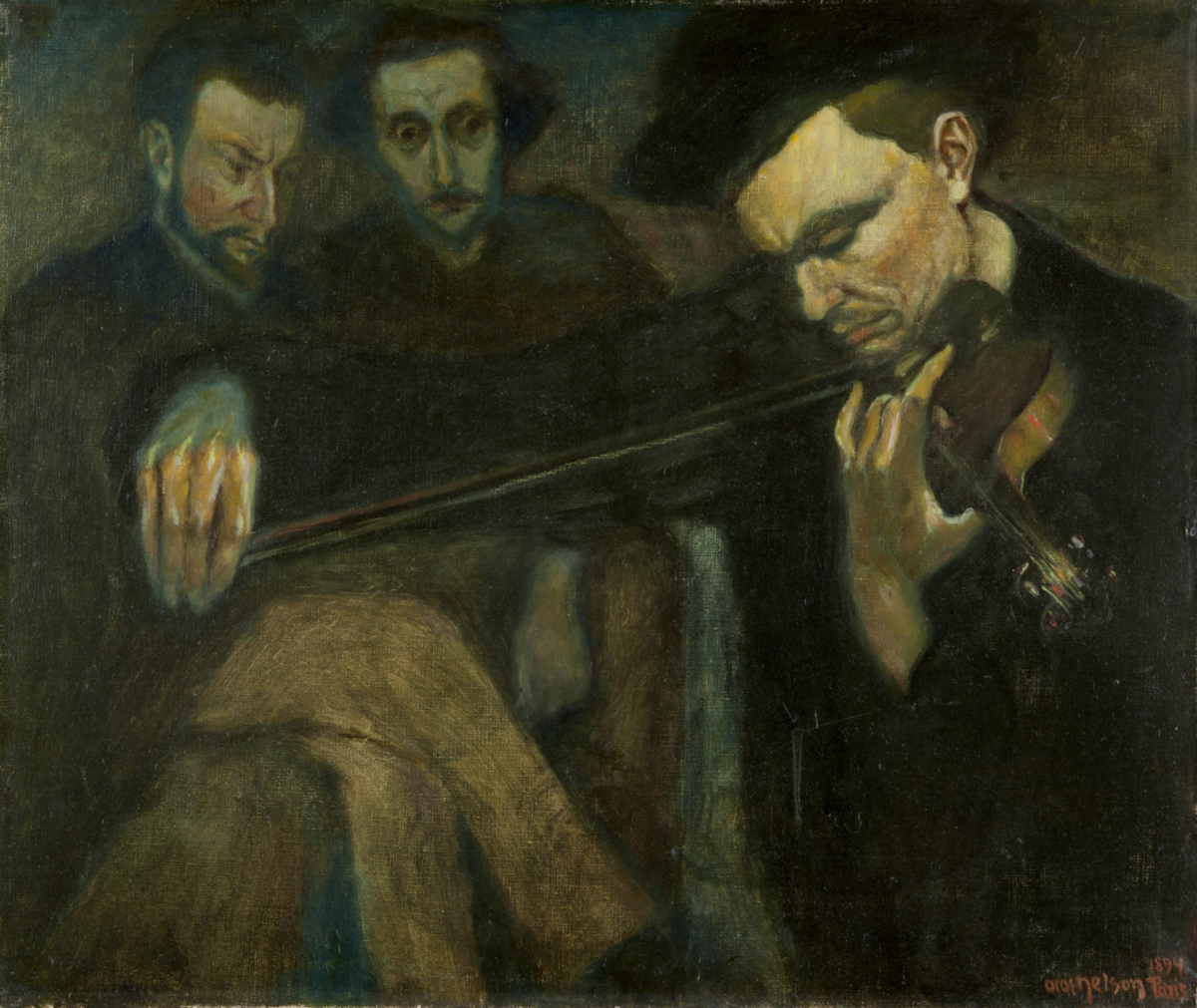
Olof Sager-Nelson (1868 - 1896)
Violin Player
Title
Violin Player
Dating
1894
Material/Technique
Oil on canvas
Dimensions
Mått 54,00 x 65,00 cm
Ram 71,50 x 82,50 x 4,00 cm
Category
Art Movement
Inventory number
F 103
Acquisition
Bequest of Pontus and Göthilda Fürstenberg, 1902
Display Status
Description
From the book “The Collection: The Gothenburg Museum of Art”, Gothenburg 2014:
In Violin Player, from the Fürstenberg collection, we get a glimpse of a private, impromptu concert in bohemian Paris. The hour is late. In the dark huddle two listeners, while the man in the foreground—the Finnish painter and violinist Väinö Blomstedt—is wholly absorbed in playing the violin. Bright light falls on the violinist’s face while the rest of the room is in darkness. The two figures in the background sit listening attentively. From a different portrait by Sager-Nelson, the man on the left can be identified as Werner von Hausen, the Finnish Symbolic painter. Elegantly dressed in pale trousers, he sits with legs crossed and eyes half closed, seen in three-quarter face. His expression is introspective. The man to his right is instead depicted full-face, and sits leaning forward with wide eyes and a sad, almost dismayed look, as if the music is speaking to the depths of his soul. The light gleams on the violin’s varnish and the violinist’s hands. The scene is painted in muted umber tones. The men’s faces are lit by a yellowish-green glow, which imbues the whole scene with a sense of doom. It is not just late at night, but also late in life, perhaps even late on Earth.
The image reflects the troubled atmosphere at the turn of the century, a time of great social change, but also sickness and death. The painting is an expression of Sager-Nelson’s quest to portray an inner state of mind rather than an external reality. This ambition was common to Synthetism and Symbolism, the art movements that were on everyone’s lips in the cafés of Paris at the time, and which he so took to heart during his stay in the city. Where the Synthetists wanted to simplify motifs in a personal interpretation, so the Symbolists took a step away from external reality to let the inner mood, dreams, and fantasies take shape in their images. Just as music works on the different temperaments of its listeners, so the artists wanted their »soulful listening« to have the same effect on their viewers.
Several studies survive for the painting, suggesting that Sager-Nelson placed great importance on how the motif should be realized. The painting was done in Blomstedt’s studio at rue Vaugirard 99 (Sager-Nelson’s studio was at 103). A study in black crayon is in the Gothenburg Museum of Art’s possession.
Kristoffer Arvidsson
Signature/Inscription
Signature (Nere till höger): 1894 Olof Nelson Paris
Exhibition History
Göteborg, Göteborgs konstmuseum, 19/09/2015 - 24/01/2016
Stockholm, 1895, no. 75
Göteborg, Göteborgs konstmuseum, 1915, no. 18
Stockholm, Nationalmuseum, 1915, no. 18
Literature
Sixten Strömbom, Konstnärsförbundets historia 2. Nationalromantik och radikalism: 1891–1920, Albert Bonniers förlag, Stockholm 1965., p. 75
Birgit Rausing, "Måleriet", Signums svenska konsthistoria. Konsten 1890–1915, Bokförlaget Signum, Lund 2001, p. 275, ill. p. 274
Nils Gösta Sandblad, "Nordiskt sekelskifte", Bildkonsten i Norden, del 3, Bokförlaget Prisma, (1950) 1972, p. 228, ill. p. 228
Georg Pauli, "Fürstenbergska galleriet. Spridda drag ur dess historia", Ord & Bild, 1902, p. 346
Georg Nordensvan, Svensk konst och svenska konstnärer i nittonde århundradet. II. Från Karl XV till sekelslutet, Ny, grundligt omarbetad upplaga, Albert Bonniers Förlag, Stockholm (1925) 1928, ill. p. 409
Ulf Thorell, Målaren Olof Sager-Nelson och mecenaten Pontus Fürstenberg. Breven berättar, Warne förlag, Partille 2004, p. 119-122, ill. p. 121
Axel Gauffin, Olof Sager-Nelson, Sveriges allmänna konstförening, Stockholm 1945, p. 181, ill. p. 193
Axel Gauffin, ”Ur Sager-Nelsons utvecklingshistoria. Ett bidrag till kännedomen om nittiotalets psyke”, Kunst og kultur, red. Harry Fett och Haakon Shetelig, John Griegs forlag, Bergen 1920, ill. p. 55
Minnesutställning över målaren Olof Sager-Nelson, Göteborgs konstmuseum, 1915, no. 18, p. 4
Im Lichtes des Nordens. Skandinavische Malerei um die Jahrhundertwende, Düsseldorf, Kunstmuseum Düsseldorf, 1986, ill. p. 40
Paris, Musée du petit palais, Lumières du Nord. La peinture scandinave 1885–1905, 1987., ill. p. 45
Carl G. Laurin, Nordisk konst IV. Sveriges och Finlands konst från 1880 till 1926, P. A. Norstedt & Söners Förlag, Stockholm 1926, p. 188, ill. p. 186
Sven Sandström, Ivar Arosenius. Hans konst och liv, Albert Bonniers Förlag, Stockholm 1959., p. 78, ill. p. 80
Karl Asplund, Ivar Arosenius, P. A. Norstedt & Söner, Stockholm 1928., p. 49
Kristoffer Arvidsson, Per Dahlström, Björn Fredlund, Anna Hyltze, Philippa Nanfeldt, Isabella Nilsson, Johan Sjöström, Samlingen Göteborgs konstmuseum, red. Kristoffer Arvidsson, Per Dahlström, Anna Hyltze, Göteborgs konstmuseum, Göteborg 2014., p. 175-176, ill. p. 177
Johannes Nordholm, "Gåtfullhetens målare. Olof Sager-Nelson och symbolismen i Paris", Arche nr 58-59, 2017., p. 153, ill. p. 153
Lotta Nylund et al., Andens rikedomar. Esoterismen och den finländska konstvärlden 1890-1950, red. Nina Kokkinen och Lotta Nylund, Parvs, Helsingfors, 2020., p. 79, ill. p. 80-81
ill. p. 101
Related theme