Bruno Liljefors (1860 - 1939)
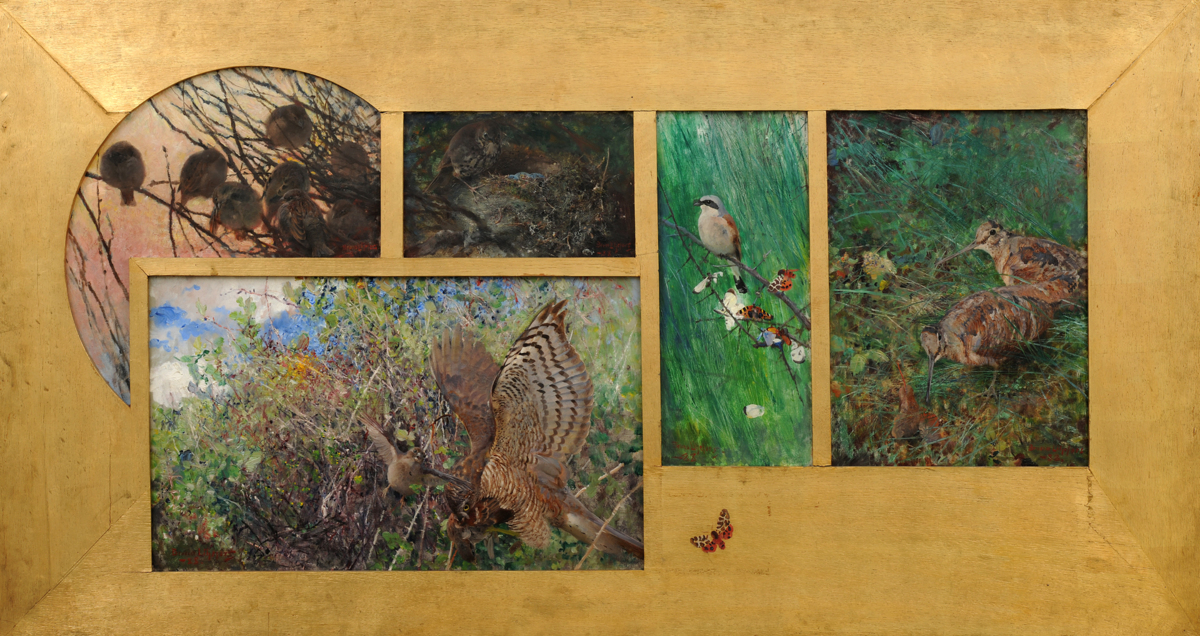
Woodcocks; Red-backed Shrike; Thrush in its Nest; Preying Hawk; Sparrows
Title
Woodcocks; Red-backed Shrike; Thrush in its Nest; Preying Hawk; Sparrows
Dating
1888
Material/Technique
Oil on panel and canvas, assemblage in gilded and painted frame
Dimensions
Mått 88,50 x 167,50 x 4,50 cm (med ram)
Mått 21,00 x 33,50 cm (F 89c, Trast vid sitt rede, andra från vänster)
Mått 41,00 x 68,50 cm (F 89d, Jagande hök, nere till vänster)
Mått 48,50 x 45,00 cm (F 89e, Gråsparvar, uppe till vänster)
Mått 49,70 x 37,00 cm (F 89a, Morkullor, längst till höger)
Mått 49,50 x 22,00 cm (F 89b, Törnskata, tredje från vänster)
Category
Art Movement
Inventory number
F 89
Acquisition
Bequest of Pontus and Göthilda Fürstenberg, 1902
Display Status
Description
By showing animals living in their natural environment, Bruno Liljefors blazed a new trail as a painter of nature. His pictures often depict a struggle for existence, as in this multi-part work about the lives of birds in five paintings assembled in a smooth gilt frame. Liljefors gives us subtle insights into the birds’ lives, switching between different perspectives. The sparrows, ruffled up and silhouetted against an apricot-coloured twilight sky, sit on the thin twigs of the picture at the top left. To the right is the thrush in its dark nest, its eggs just visible, while underneath the hawk swoops on its prey in a thicket. Then comes the shrike, perched on a branch with butterflies against intensely lush, green grass, and finally the mottled brown woodcock, foraging in the grass with their long, narrow beaks. There is an interplay between them that creates a sense of motion across the composition as a whole. Liljefors switches effectively between calm intimacy and dramatic hunting scenes, close-ups and panoramic views, portrait and landscape formats. The format, cropping, composition, and calligraphic brushwork are reminiscent of Japanese woodcuts. Cleverly, Liljefors evokes texture, plumage, and vegetation with different techniques, which include drawing into the paint with the end of the paintbrush. This is not only an accurate nature study, but also a dramatization that gives us a glimpse of the lives of birds, assembled into a larger composition that speaks to the nature of existence. One senses a Darwinian perspective, where the struggle to survive is central.
Kristoffer Arvidsson from The Collection Gothenburg Museum of Art, Gothenburg 2014
Signature/Inscription
Signature: Bruno Liljefors -8(8?)
Literature
Bruno Liljefors. 60 reproduktioner i tontryck efter fotogrfier af originalen, Gleerupska Universitets-bokhandeln, Lund 1910, ill. p. 7
Torsten Gunnarsson, ”The Japonisme of Carl Larsson and Contemporary Swedish Art”, The painter of Swedish life, Carl Larsson/Suwēden no kokumin gaka Karu Rashon ten, Tokyo Metropolitan Teien Art Museum, Tokyo 1994, p. 175-178, ill. p. 170, fig. 2
Kristoffer Arvidsson, Per Dahlström, Björn Fredlund, Anna Hyltze, Philippa Nanfeldt, Isabella Nilsson, Johan Sjöström, Samlingen Göteborgs konstmuseum, red. Kristoffer Arvidsson, Per Dahlström, Anna Hyltze, Göteborgs konstmuseum, Göteborg 2014., p. 157, ill. p. 158-159
Weblink
Related theme