Per Hasselberg (1850 - 1894)
The Water Lily
Title
The Water Lily
Dating
1891 - 1896
Material/Technique
Marble
Dimensions
Mått 60,00 x 169,00 x 70,00 cm
Category
Art Movement
Inventory number
F 187
Acquisition
Bequest of Pontus and Göthilda Fürstenberg, 1902
Display Status
Description
From the book “The Collection: The Gothenburg Museum of Art”, Gothenburg 2014:
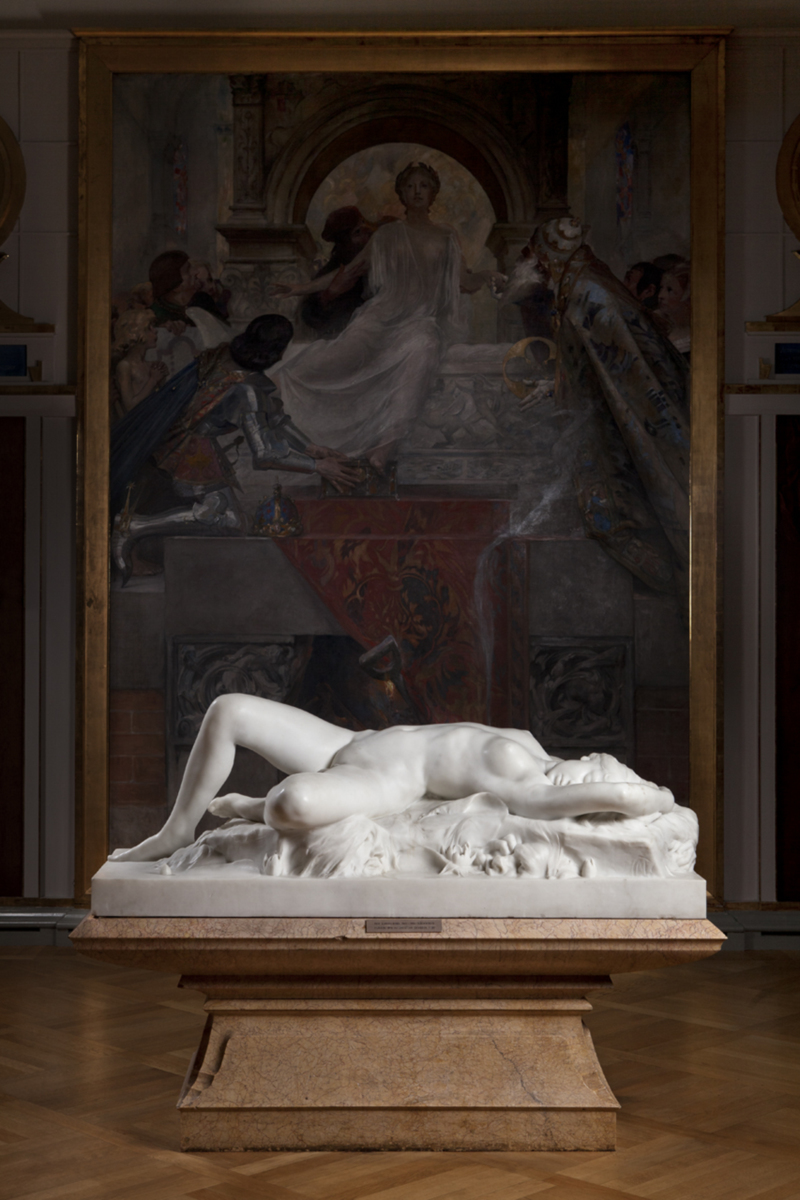
For the unashamedly erotic one turns to The Water Lily, with a young woman lying on her back, outstretched. Her right leg is angled so that her foot is on the ground, her left leg is bent underneath it. Her arms are extended above her head, which is turned to one side. Her eyes are closed, her mouth half open. The girl is laid out for the observer, but seems unaware that she is being observed. A voyeuristic gaze thus seems inscribed in the work. The closed eyes and body movement emphasize the sensual and erotic challenge presented by her pose.
The figure is floating on leaf-like shapes. Around her, water lilies are growing. The artist establishes a similarity between the outstretched woman and the water lilies to create a symbol of Nature’s processes. The water lily is rooted in the bottom of the lake and grows to the surface of the water, where its beauty attracts insects to fertilize it. Similarly, the young woman has grown from childhood to youth in order to attract men with her beauty.
The flower took its name, Nymphaea, from the Greek word for nymph. The nymphs were supernatural beings in Greek mythology. The Water Lily was said to have been born when a nymph died of jealousy. The mythical overtones are strengthened by a bearded, coarse face, reminiscent of a satyr’s, emerging from the marble at her side. With its fairy-tale setting, The Water Lily is a suggestive, vital image.
To the modern eye, it may seem awkward that young women’s bodies are used to symbolize abstract ideas, but this was a very common type of picture in the nineteenth century. Nakedness was legitimized by being contained in an allegorical programme. Hasselberg’s sculptures were done in a transitional phase as the academic framework was beginning to fall away, leaving the body’s sensuality unadorned by a mythological setting. The Water Lily still has a symbolic dimension, but is nevertheless challenging in its physicality.
The Water Lily dates to after Hasselberg’s return to Sweden in 1891, and became something of an artistic testament. The model was Signe Larsson, with whom Hasselberg had a child after he and the artist Eva Bonnier had broken off their engagement. After Hasselberg died in 1894, Eva Bonnier adopted Hasselberg and Larsson’s daughter.
The sculpture was completed in time for the Chicago World’s Fair in 1893, and later was shown at the Artists’ Association exhibition in 1894. The marble version in the Fürstenberg Gallery was not carved until 1896, after Hasselberg’s death, by his friend Christian Eriksson.
Kristoffer Arvidsson
Signature/Inscription
Inscriptions: P. Hasselberg enligt den avlidne bildhuggarens önskan huggen av Chr. Eriksson 1896.
Exhibition History
Chicago, 1893
Literature
Sixten Strömbom, Konstnärsförbundets historia 2. Nationalromantik och radikalism: 1891–1920, Albert Bonniers förlag, Stockholm 1965., p. 57, 72, 117-118, 153, 156-157, 158, 159, 176, 394, ill. p. bild 28
Nils Gösta Sandblad, "Nordiskt sekelskifte", Bildkonsten i Norden, del 3, Bokförlaget Prisma, (1950) 1972, p. 186, ill. p. 186
Eva-Lena Karlsson, "Skulpturen", Signums svenska konsthistoria. Konsten 1890–1915, Bokförlaget Signum, Lund 2001, p. 189-190
Georg Nordensvan, Svensk konst och svenska konstnärer i nittonde århundradet. II. Från Karl XV till sekelslutet, Ny, grundligt omarbetad upplaga, Albert Bonniers Förlag, Stockholm (1925) 1928, p. 323, 462-463, 469, ill. p. 463
Hans-Olof Boström, Sett. Essäer om 1800- och 1900-talskonst, Carlssons, Stockholm 1992, p. 206, 210
Carl G. Laurin, Nordisk konst IV. Sveriges och Finlands konst från 1880 till 1926, P. A. Norstedt & Söners Förlag, Stockholm 1926, p. 284
Axel L. Romdahl, "Per Hasselberg. En återblick av Axel L. Romdahl", Konsthistorisk tidskrift, 1932, p. 2-3, ill. p. 5
Karl Wåhlin, "Pehr Hasselberg. Med 12 bilder", Ord & Bild, 1894, p. 238
Lennart Wærn, "In memoriam Coco et Coco redivivus", Det skapande jaget. Konsthistoriska texter tillägnade Maj-Brit Wadell, red. Irja Bergström, Konstvetenskapliga institutionen, Göteborgs universitet, 1996, p. 123, 130
Ulf Torell, Per Hasselberg. Den nakna sensualismens skulptör, Ronneby hembygdsförening, Ronneby 2007, p. 172, 212, 239, 241-248, 257, 277, 294, 305, ill. p. 254
David Finn, How to Look at Sculpture, Harry N. Abrams, Inc., Publishers, New York 1989., p. 99, ill. p. 99
Klas Fåhræus, "Näckrosen. Till Pehr Hasselberg", Ord & Bild, 1894
Nils Gösta Sandblad, "Nordiskt sekelskifte", Tidens konsthistoria III, 1950, ill. p. 477
David Finn, "Discovering Per Hasselberg", Sculpture Review, Spring, vol. XLIII, nr 1, 1994, p. 19, ill. p. 20, 23
Lillie Fischer, Per Hasselberg. Snöklockans, Grodans, Näckrosens skapare, Nya Antik & Auktion nr 12, 1978, p. 30, 31, 33, ill. p. 31
Elsebeth Welander-Berggren, Annika Gunnarsson, Åsa Cavalli-Björkman, Jessica Sjöholm Skrubbe, Christina G. Wistman, Anna Meister, Per Hasselberg (1850–1894), red. Annika Gunnarsson, Anna Meister, Elsebeth Welander-Berggren et al., Prins Eugens Waldemarsudde, Arena/Åmells Art Books, Stockholm 2010., p. 7, 18, 41, 64-65, 67-74, 85, 90-93, 105, 108-110, 111, 113, 115, 121
Ragnar Båge, "Per Hasselberg. Ett bidrag till kännedom om vår frejdade bildhuggare", Särtryck ur Blekingeboken 1934. Blekinge musei- och hembygdsförbunds årsbok, Blekinge musei- och hembygdsförbund, Karlskrona 1934., p. 1, 36, 40-41, 48
Ragnar Båge, Vallpojken som blev marmorns skald. Ett bidrag till kännedomen om vår frejdade bildhuggare, P. A. Norstedt & söners förlag, Karlshamn 1933, p. 56, 60, 65-70, 72, 76, 77
Richard Bergh, Per Hasselberg 1850–1894. Minnesblad, red. F. U. Wrangel, R. Bergh, Alf Wallander, Birger Mörner, Karl Wåhlin, Sveriges Allmänna Konstförening, Stockholm 1898, p. 11, 30-35, ill. p. 39
Kristoffer Arvidsson, Per Dahlström, Björn Fredlund, Anna Hyltze, Philippa Nanfeldt, Isabella Nilsson, Johan Sjöström, Samlingen Göteborgs konstmuseum, red. Kristoffer Arvidsson, Per Dahlström, Anna Hyltze, Göteborgs konstmuseum, Göteborg 2014., p. 132, 139, ill. p. 138
Related theme