Edouard Dantan (1848 - 1897)
Casting from Life
Title
Casting from Life
Dating
1887
Material/Technique
Oil on canvas
Dimensions
Mått 165,00 x 131,50 cm
Ram 175,50 x 140,50 x 2,50 cm
Category
Art Movement
Inventory number
F 21
Acquisition
Bequest of Pontus and Göthilda Fürstenberg, 1902
Display Status
Description
From the book “The Collection: The Gothenburg Museum of Art”, Gothenburg 2014:
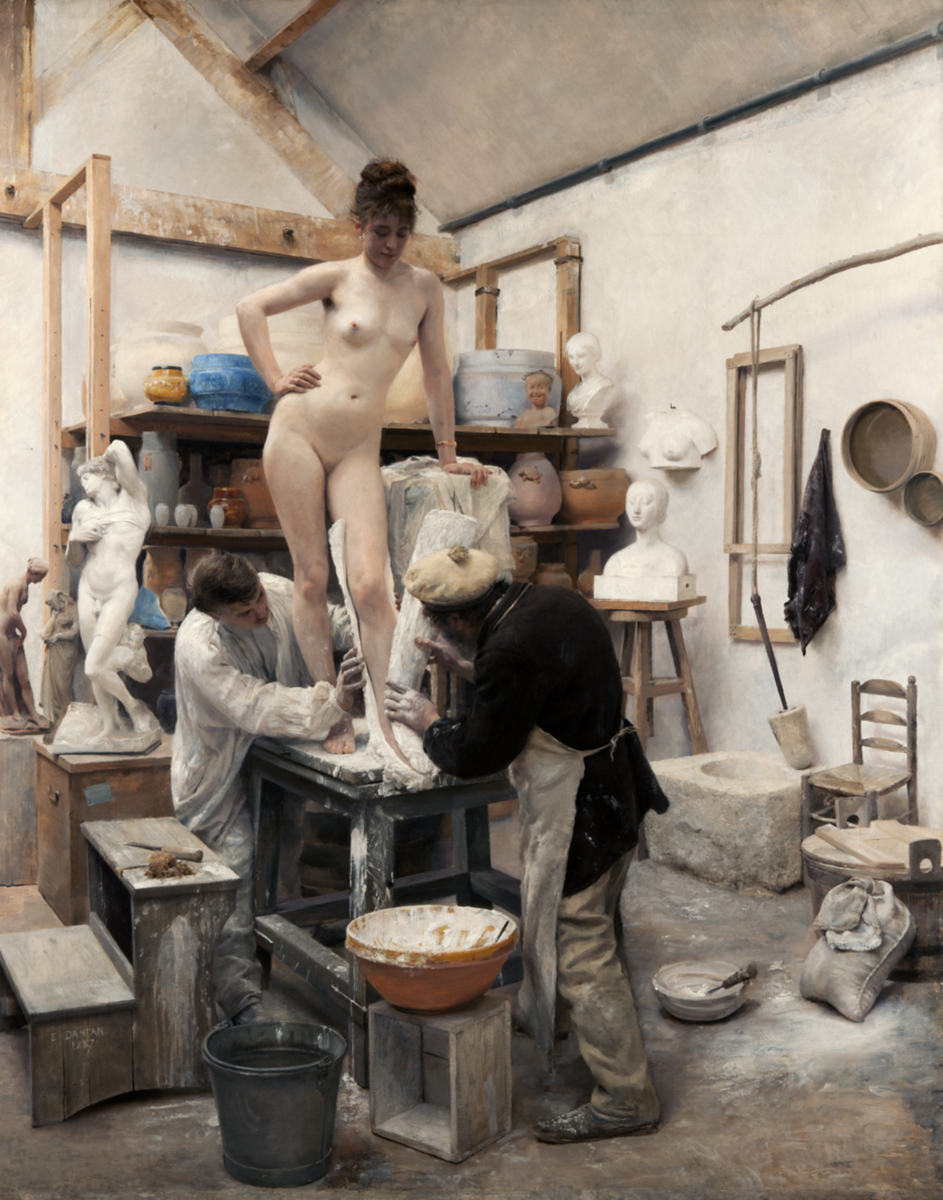
Casting from Life shows the interior of a sculpture workshop, a setting with which the artist was familiar because his father was a sculptor. A sculptor and his assistant are in the process of taking a cast of a female model who is standing on a pedestal with one hand on her hip and the other leaning on a modelling stand. The sculptor, who has his back to the viewer, is in the process of loosening the cast from the model’s leg. Next to him stands a bowl in which the plaster is mixed. On a set of steps lies a lump of clay and a knife. In the background is a plaster copy of Michelangelo’s The Dying Slave, female figures in terracotta, pots, and plaster busts. Although the painting gives a credible picture of the work of a sculptor’s studio, at the same time there are idealized and mythical undertones from art history and the ancient Pygmalion myth.
Ovid tells in his Metamorphoses of the Cypriot sculptor Pygmalion who fell in love with the female statue in ivory that he carved. He prayed to Venus, who brought the sculpture to life. Pygmalion later became the archetype of the Romantic artist’s dream of creating a living work.
The myth was painted in several versions by the academic painter Jean-Léon Gérôme, who was Dantan’s contemporary. In Dantan the situation is reversed. The sculptor is taking a cast of a living woman in order to create a »dead« sculpture, giving the myth a more prosaic setting. Bearing in mind the replica of Michelangelo’s The Dying Slave in the background, with the man’s hopeless struggle to free himself from his fate, one can possibly read it as a comment on the captivity and liberation of women in the late nineteenth century, a time when women’s emancipation was hotly debated.
Kristoffer Arvidsson
Signature/Inscription
Signature (Nere till vänster): E. DANTAN 1887.
Exhibition History
Stockholm, Nationalmuseum, 03/03/2005 - 22/05/2005, no. 187
Madrid, Museo Nacional Centro de Arte Reina Sofia, 15/10/2002 - 06/01/2003, no. 148
Centre de Cultura Contemporània de Barcelona, 30/05/2002 - 08/09/2002, no. 148
Leeds, Henry Moore Institute, 16/02/2002 - 12/05/2002, no. 47
Paris, Musée d’Orsay, 29/10/2001 - 27/01/2002, no. 47
München, Lenbachhaus, 08/09/2001 - 25/11/2001
Stockholm, Nationalmuseum, 08/02/1991 - 07/04/1991
Paris, Galeries nationale du Gran Palais, 10/04/1986 - 28/07/1986
Paris, 1889, no. 385
Literature
Georg Pauli, "Fürstenbergska galleriet. Spridda drag ur dess historia", Ord & Bild, 1902, p. 347-349
The Gaudi Universe, Centre de Cultura Contemporània de Barcelona, red. Juan José Lahuerta, Museo Nacional Centro de Arte Reina Sofia, CCCB Barcelona, 2002, no. 148, p. 84-85.
Material in Kunst und Alltag, red. Monika Wagner och Dietmar Rübel, Akademie Verlag, 2002, ill. p. 139
Ragnar Josephson, Nils Gösta Sandblad, Gösta Lilja, Svenska skulpturidéer 2, red. Ragnar Josephson, Nils Gösta Sandblad, Gösta Lilja, Allhem, Malmö 1952, p. 100
Maria Görts, Det sköna i verklighetens värld. Akademisk konstsyn i Sverige under senare delen av 1800-talet, diss. Stockholms universitet 1999, Typsnittsarna Prepress, Bjärnum 1999, p. 101
New History of World Art (japanska), Shogakuhan, Tokyo 1993
Elmar Stolpe, Mißachtete Kunst – neu gesehen”, Weltkunst juli 1986, 1986, p. 186, ill. p. 186
Richard Muther, Gerichte der Malerei im 19. Jahrhundert, band 3, München 1894, p. 39, ill. p. 39
Ingemar Pettersson, ”Kvinnan i salongsmåleriet. Fåraktig uppsyn och mjällvit hud”, Göteborgs-Tidningen, 1980-08-08, 1980
Marie Renard, Självbiografisk text, (Renard stod modell för verket), kopia på Göteborgs konstmuseum.,
Barbara Eschenburg, Pygmalions Werkstatt. Die Erschaffung des Menschen im Atelier von der Renaissance bis zum Surrealismus, Lenbachhaus, München, 8 september–25 november 2001, Lenbachhaus, München 2001
La Sculpture Française au XIXe siecle. Galeries nationale du Grand Palais, Paris, Paris 1986, no. fig. 83
Kroppen. Konst och Vetenskap, Nationalmuseum, Stockholm, 2005, no. 187
Paris, Exposition Universelle de 1889. Beaux-Arts 1789-1889. Catalogue Illustre des Beaux-Arts, red. F-G Dumas, Paris 1889., no. 385, p. 179, ill. p. 179
Lennart Wærn, Pontus Fürstenberg som samlare, Konsthistorisk tidskrift, årg. LVII, häfte 3-4, Stockholm 1988, p. 25
Frédérique Thomas-Maurin et al., Courbet – Clesinger. Œuvres croisées, Musée Gustave Courbet, Éditions du Sekoya, 2011., p. 79, ill. p. 80 fig. 2
Björn Fredlund, Ivar Arosenius, Bokförlaget Signum i Lund, Stockholm 2009., p. 182
Barbro Ahlfort, Lena Boëthius, Ingmari Desaix, Folke Edwards, Björn Fredlund, Jonas Gavel, Barbro Löfquist, Anne Pettersson, Håkan Wettre, Göteborgs konstmuseum dess historia och samlingar, red. Håkan Wettre, Palmeblad, Göteborg 1992., p. 10, ill. p. 10
Kristoffer Arvidsson, Per Dahlström, Björn Fredlund, Anna Hyltze, Philippa Nanfeldt, Isabella Nilsson, Johan Sjöström, Samlingen Göteborgs konstmuseum, red. Kristoffer Arvidsson, Per Dahlström, Anna Hyltze, Göteborgs konstmuseum, Göteborg 2014., p. 183, ill. p. 184
Veronika Tocha, Near Life. 200 Years of Casting Plaster, red., Staatliche Museen zu Berlin, Prestel, Berlin, München, London, New York, 2019., p. 145, ill. p. 144, 257
Carina Rech, Becoming Artists. Self-Portraits, Friendship Images and Studio Scenes by Nordic Women Painters in the 1880s, red., Makadam/diss. Stockholms universitet 2021, Stockholm, 2021., p. 249-250, ill. p. 249
Weblink
Related theme