Ernst Josephson (1851 - 1906)
The Water Sprite
Title
The Water Sprite
Dating
1882 - 1884
Material/Technique
Oil on canvas
Dimensions
Mått 146,50 x 114,00 cm
Ram 185,00 x 153,00 x 14,00 cm
Category
Art Movement
Inventory number
F 215
Acquisition
Bequest of Pontus and Göthilda Fürstenberg, 1902
Display Status
Description
From the book “The Collection: The Gothenburg Museum of Art”, Gothenburg 2014:
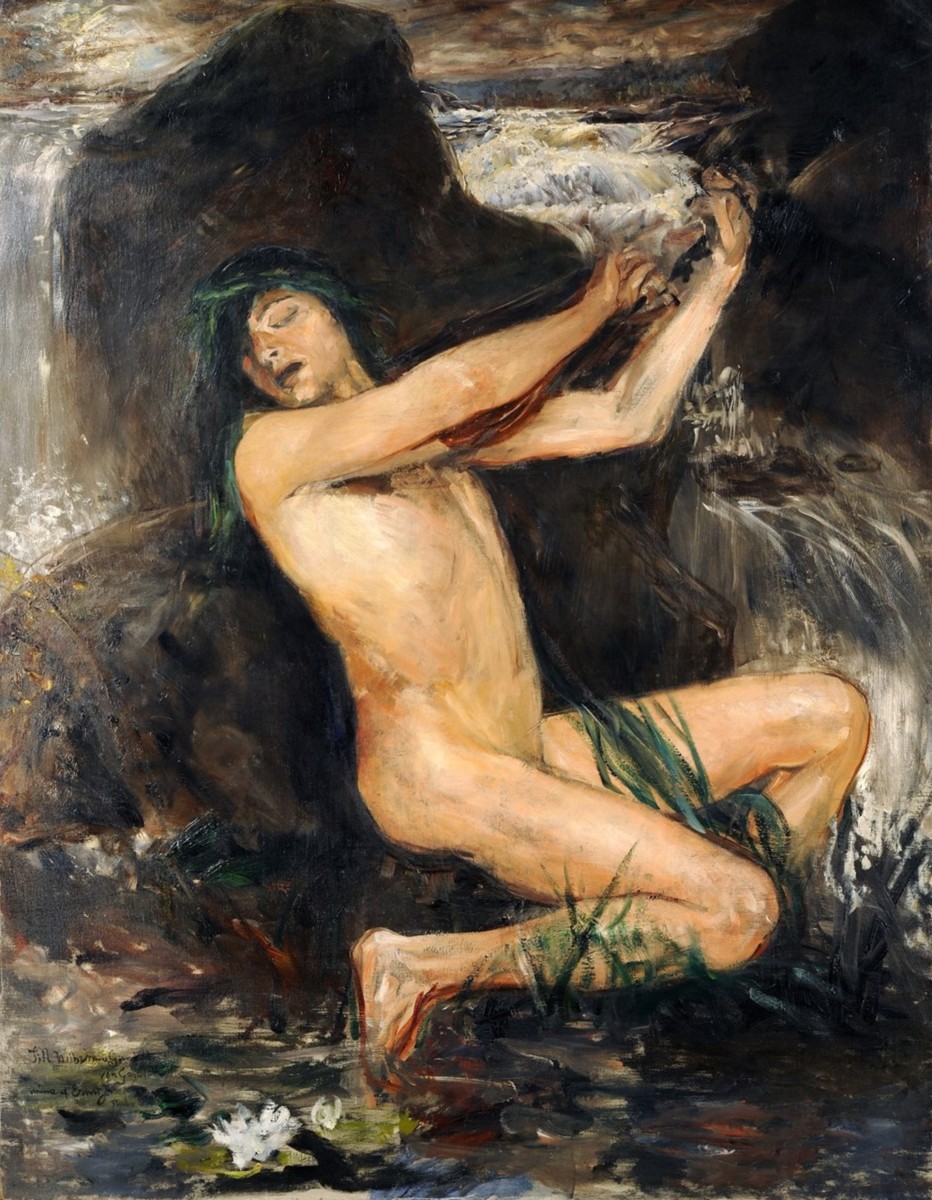
The water sprite is sitting by a stream, his arms raised to play his violin. His body turns in a spiral, creating a zigzag motion in the composition. Waving reeds grow around his legs and thigh and form a green crown on his head. His naked body is silhouetted against a dark cliff. On both sides, torrents of water fall precipitously from a river or lake at the top of the picture. Beyond the water there is a glimpse of distant landscape and a partly overcast sky. In the foreground, lily pads and two white water lilies float on calmer water.
Quickly, deftly, the water sprite wields his violin. The instrument’s shape is only implied and the bow has been painted over. Playing, the water sprite throws his head back, eyes closed, mouth half open in ecstasy. When he plays, he is at one with the music.
The image is strikingly fluid and expressively painted, and the artist has worked alternately with dark surfaces, balanced volumes, and contour lines around the arms and legs. The painting has been done in rough tones, reminiscent of the colour scale of a Velázquez or a Rembrandt.
The water sprite is an elemental being, a spirit in Scandinavian folklore who plays the fiddle or harp to attract young women whom he drags down to the depths. The motif has an erotic quality that is underscored by Josephson’s choice to paint the water sprite as young. The water sprite can also be seen as the essence of the obsessive and melancholy artist, forced to sacrifice companionship to create his works. The motif’s strong meaning for Josephson—he kept returning to it throughout his life—stems from his identification with the water sprite. The creature’s ecstasy and obsession are his own.
The image first originated from the Trollhättan Falls, which Josephson visited. The idea took shape during Josephson’s visit to Eggedal in Norway with his Norwegian friend from the Academy of Arts, Wilhelm Peters, in 1872. They also visited Numedalen, with its majestic waterfalls, and Sætesdalen. Yet it was only once he was in Rome in the late 1870s that Josephson tried his hand at sketching the subject. In Paris in 1881 he began work on the design in earnest, and went on to rework it over a period of several years.
In the so-called Lindeberg Sketch (Thiel Gallery), the sprite has turned to the right and throws back his head as he plays. The Nationalmuseum has the better-finished Van Gogh Sketch (the painting was owned by Theo Van Gogh). The Nationalmuseum also possesses a more elaborate version of the subject in tempera, the water sprite wreathed in a Romantic haze, and in the sky a yellow crescent moon.
In comparison, the version in the Fürstenberg Gallery has stronger contrasts and more expressive brushwork. The crescent moon is gone. An X-ray photograph taken in the 1950s showed an underlying sketch of a reclining nude woman. The Gothenburg version seems to have been completed after the painting in the Nationalmuseum, however.
In the summer of 1884, Josephson returned to Eggedal in Norway to paint the final version, The Nixie. The finished painting was a synthesis of the previous versions, with the subject now seen in naturalism’s clear light of day.
Josephson’s ambitious undertaking ended in a humiliating defeat. The Nixie was rejected by the Salon jury of 1885, and when the painting was put into the Opponents’ exhibition in Stockholm in the autumn of the same year, it was deliberately shown to disadvantage, hung unfavourably high, just below the ceiling. The Nixie met with derision from the public and critics alike. Unsurprisingly, perhaps, given that the painting was about the artist’s agonizing alienation, which for Josephson’s part would soon enough develop into self-imposed isolation. Vindication came in 1893, when Richard Bergh and other artist friends from his Opponent years organized his first solo exhibition in Stockholm. At the exhibition, Prince Eugen bought The Nixie. After unsuccessfully offering the painting as a gift to the Nationalmuseum, it remained in his possession, and to this day is still to be seen at Prince Eugen’s Waldemarsudde. The Gothenburg version was a present from Wilhelm von Gegerfelt to Pontus Fürstenberg.
Kristoffer Arvidsson
Signature/Inscription
Signature: Ernst Josephson Paris
Inscriptions: Till Wilhelm och Gunhild von Gegerfelts minne av Ernst Josephson Paris 8 (?)
Exhibition History
Stockholm, Prins Eugens Waldemarsudde, 12/10/2001 - 15/01/2002, no. 45
Åbo, Åbo Konstmuseum, 19/09/1991 - 27/10/1991
Stockholm, Liljevalchs konsthall, 1951, no. 151
Stockholm, Prins Eugens Waldemarsudde, 1991, no. 46
Literature
Einar Rosenborg, Svenska konstnärer 3. Ernst Josephson, Richard Bergh, Karl Nordström, Carl Wilhelmson, J. A. Lindblads Förlag, Uppsala 1926, p. 13-14, 19-21
Bo Lindwall, "Nordiskt friluftsmåleri", Bildkonsten i Norden, del 3, Bokförlaget Prisma, Stockholm (1950) 1972., p. 156-158
Jonas Gavel, "Carl Larsson och Pontus Fürstenberg", Carl Larsson. Göteborgs konstmuseum 6 juni–30 september 1992, red. Torsten Gunnarsson, Göteborgs konstmuseum och Bra böcker, Göteborg 1992., p. 250
Georg Nordensvan, "I Göteborgs Museum. Några intryck af Georg Nordensvan", Ord & Bild, red. Karl Whålin, Ord & Bild/Wahlström & Widstrand, 1906, p. 22
Georg Nordensvan, Svensk konst och svenska konstnärer i nittonde århundradet. II. Från Karl XV till sekelslutet, Ny, grundligt omarbetad upplaga, Albert Bonniers Förlag, Stockholm (1925) 1928, p. 270-271
Sven Sandström, Konsten i Sverige. Det sena 1800-talet – bildkonst och miljökonst, red. Sven Sandström, AWE/Gebers, Almqvist & Wiksell Förlag AB, Stockholm 1975, p. 77
Sixten Strömbom, Konstnärsförbundets historia till och med 1890, Albert Bonniers förlag, Stockholm 1945, p. 162-163, 167, ill. p. bild 55
Ernst Josephson. 60 reproduktioner i tontryck efter fotografier af originalen, Gleerupska universitets-bokhandeln, Lund , ill. p. 41
Carl Larsson, utg. av Torsten Gunnarsson, Stockholm/Göteborg, 1992, p. 250
Axel L. Romdahl, Göteborgs konstmuseum. Tvåhundra bilder med inledande text av Axel L. Romdahl, Medéns bokhandels aktiebolag, Göteborg 1925., ill. p. 165
Lennart Wærn, Pontus Fürstenberg som samlare, Konsthistorisk tidskrift, årg. LVII, häfte 3-4, Stockholm 1988, p. 27, ill. p. 26
Hans Henrik Brummer, Ernst Josephson. Målare och diktare, Norstedts, Stockholm 2001., no. 45, p. 74-95, 266-267, ill. p. 82
Karl Wåhlin, Ernst Josephson 1851–1906. En minnesteckning, senare delen. II 1879–1906, Sveriges Allmänna konstförening, Stockholm 1911, p. 68-72, ill. p. 67
Erik Blomberg, Ernst Josephsons konst. Från Näcken till Gåslisa, P.A. Norstedt & Söner förlag, Stockholm 1959, p. 22-58, 60, ill. p. 23, 33, 34, 35
Erik Blomberg, Ernst Josephson. Svenska konstnärer, Förlagsaktiebolaget, Göteborg 1945, p. 19
Ulf Abel, Ernst Josephson, Nationalmuseum och Natur och kultur, Stockholm 2004, p. 20
Per-Olov Zennström, Ernst Josephson, Norstedts, Stockholm 1946, p. 128, 130-131, ill. p. fig. 28
Erik Blomberg, Ernst Josephson. Minnesutställning. Utställning anordnad av Nationalmuseum, Göteborgs Konstmuseum och Liljevalchs Konsthall, red. Erik blomberg, Folke Holmér, Ingrid Mesterton, Liljevalchs Konsthall, Stockholm 1951., no. 151
Georg Pauli, E. Josephson. En studie, Aktiebolaget Ljus, Stockholm 1902, p. 10-16
Ingrid Mesterton, Ernst Josephson. Peintures et dessins 1888–1906, Editions Pierre Jean Oswald, Paris 1976, ill. p. 49
Erik Blomberg, Ernst Josephson. Hans liv, Wahlström & Widstrand, Stockholm 1951, p. 281-306, 406, ill. p. 303
Ingrid Jacobsson, Näckenmotivet hos Ernst Josephson. Ett tema med variationer, Wettergren & Kerbers förlag, Göteborg 1946, p. 3, 20, 30-31, 35-38, ill. p. 2
Kristoffer Arvidsson, Per Dahlström, Björn Fredlund, Anna Hyltze, Philippa Nanfeldt, Isabella Nilsson, Johan Sjöström, Samlingen Göteborgs konstmuseum, red. Kristoffer Arvidsson, Per Dahlström, Anna Hyltze, Göteborgs konstmuseum, Göteborg 2014., p. 134, 146, 148, ill. p. 147
Isaac Grünewald, "Opponenterna av 1885", Paletten nr 2 1945, Göteborg 1945., p. opag., ill. p. opag.
Erik Blomberg, "Nya Näcken-skisser", Konstrevy årg. XXXI häfte 4, 1955., p. 183-189, ill. p. 183
Axel L. Romdahl, "Göteborgs Konstmuseum", Konstrevy, specialnummer om Göteborg, årg. XV, red., 1939., ill. p. 10
Karin Sidénoch Hans Henrik Brummeroch Charlotta Nordströmoch Anders Cullhedoch Anders Hammarlundoch Birte Bruchmüller, Ernst Josephson. Konst, poesi & musik, red. Karin Sidén, Birte Bruchmüller, Catrin Lundberg, Prins Eugens Waldemarsudde, Stockholm, 2023., no. 26, p. 52-53, 69, ill. p. 58
Weblink
Related theme