Anna Maria Ehrenstrahl (1666 - 1729)
Allegory Over Spring
Title
Allegory Over Spring
Dating
1687
Material/Technique
Oil on canvas
Dimensions
Mått 122,00 x 146,00 cm
Ram 136,50 x 159,50 x 10,00 cm Skev, djupmått varierar
Category
Inventory number
GKM 2023-34
Acquisition
Purchase, 2023
Display Status
Description
Anna Maria Ehrenstrahl was the daughter of the court painter David Klöcker Ehrenstrahl (1628–1698), who had immigrated from Germany and was active in Stockholm in the late 17th and early 18th centuries.
For successful artists, the business – like all other crafts – was a business with several employees, students and assistants. It was often run as a family business where the father of the family held the title of master and signed the works, but where the wife as well as sons and daughters could be involved.
Anna Maria Ehrenstrahl was trained by her father. There she worked with portraits and copying paintings. Copying was a reputable and sought-after activity in the art world of the time. It did not involve mechanical imitation, the copies could differ in size and style compared to the original.
Ehrenstrahl married in 1688 and did not need to be professionally active for a living, but he still continued to paint throughout his life and seems to have been respected as an artist. There are only a few works signed by her, but it can be assumed that the majority of her production is hidden under her father’s name.
Anna Maria Ehrenstrahl is best known for six portraits of the former presidents of the Svea Court of Appeal donated to the Court of Appeal in 1717. On this occasion, the poet Sophia Elisabet Brenner wrote a tribute poem, in which she highlighted Anna Maria Ehrenstrahl as Sweden’s first female painter.
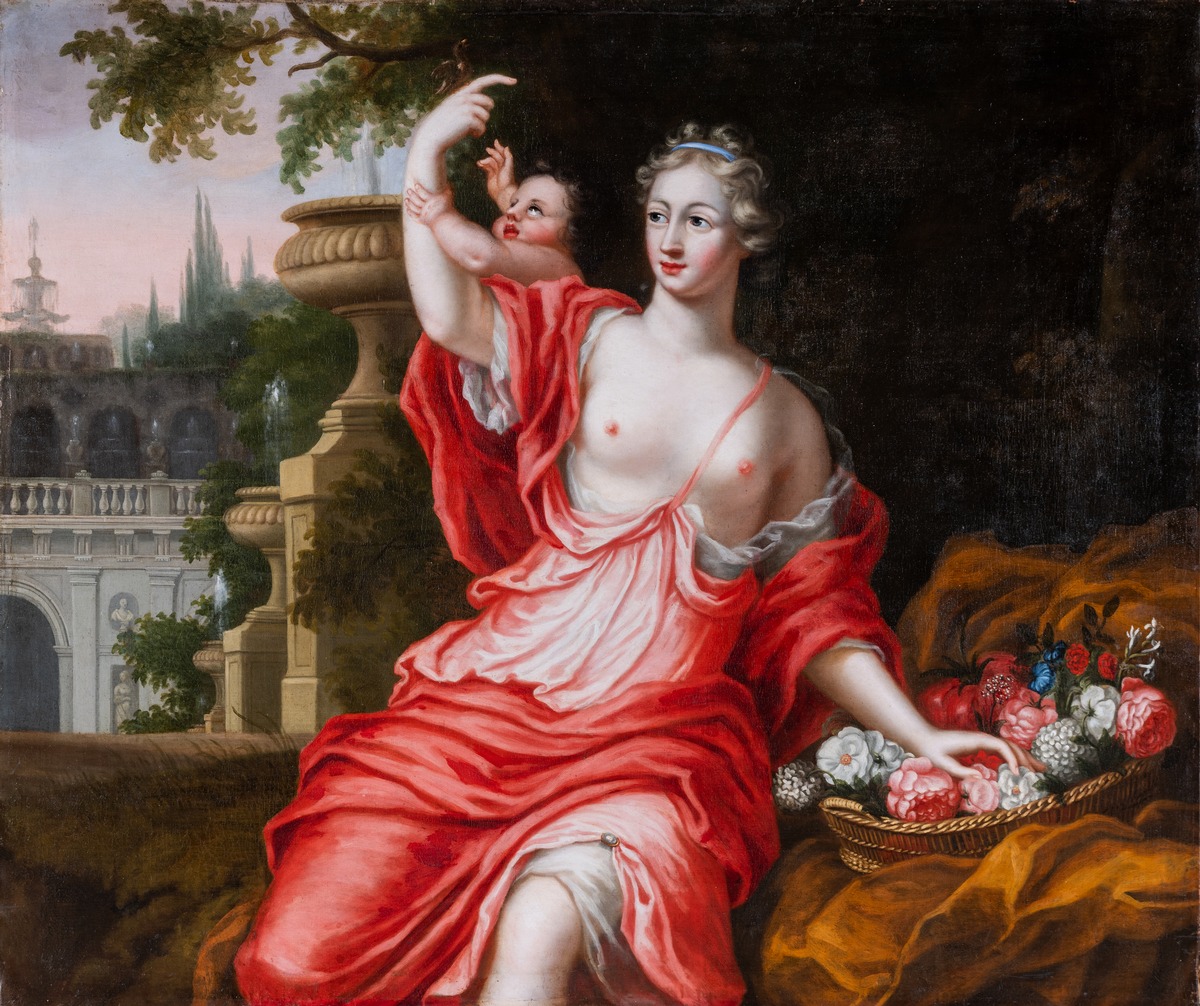
Anna Maria Ehrenstrahl’s Allegory of Spring was purchased for the museum in 2023. On the back it is signed ‘Anna Maria Ehrenstrahl fecit (painted) anno 1687’. According to reports, she painted four allegories of the seasons that year. The painting shows a woman depicted with bare breasts as an ancient goddess in a fantasy landscape with classical architecture. She is a personification of spring. In her left hand she holds a basket of flowers and on her right outstretched arm climbs a chubby child (a cherub) reaching for a bird on the woman’s hand.
Allegories are stories or images with a hidden message, which in the visual arts take the form of rebus-like picture puzzles that are expanded into a whole story with the help of symbols. They became very popular during the Baroque period in the 17th century. The meaning, which can now be difficult to understand, was for the contemporary art connoisseur to decipher through iconographic handbooks such as Cesare Ripa’s Iconologia. It was first published in 1593, but new editions were printed several times during the 17th century. Since ancient times, allegories had been used to illustrate abstract philosophical concepts and human qualities such as justice, truth, the seasons, virtue or envy with specific objects and figures. Allegories could be used to convey a provocative message without mentioning things by their proper names.
Per Dahlström
Signature/Inscription
Inscriptions (a tergo dukens baksida): Anna Maria Ehrenstrahl Fecit Ao 1687
Inscriptions (a tergo dukens baksida): No 66