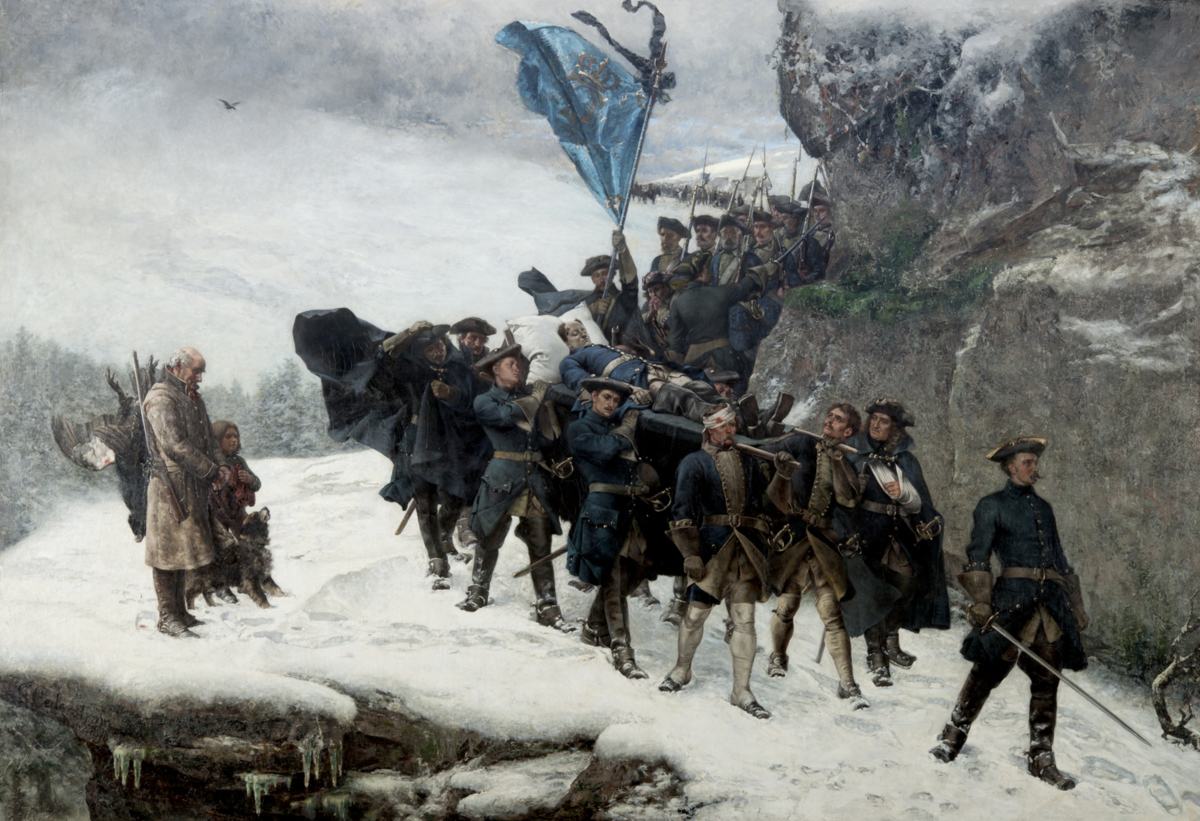
Gustaf Cederström (1845 - 1933)
The Body of Charles XII of Sweden Being Carried Home from Norway
Title
The Body of Charles XII of Sweden Being Carried Home from Norway
Dating
1878
Material/Technique
Oil on canvas
Dimensions
Mått 256,00 x 370,00 cm
Ram 289,00 x 402,50 x 9,00 cm
Category
Inventory number
GKM 1100
Acquisition
Gift of Gustaf Werner, 1939
Display Status
Description
With heavy tread, the Swedish soldiers cross the mountains with their king, killed by a shot to the head during the siege of Fredriksten fortress in Halden. A hunter and his son have stopped to watch the passing army. The royal standard whips in the freezing wind. The line of men snakes around the rock wall to the right and can be seen back to the horizon, where the sun is breaking through the clouds. The harsh winter weather amplifies the sense of grief.
A great admirer of Charles XII, it was Cederström himself who chose the subject for the canvas intended for the imminent world’s fair in Paris. He was meticulous with the details, and in the end the painting took over a year to complete. Relatives, friends, and locals posed for him in his studio. Copies of uniforms were ordered from Sweden and salt was used as artificial snow to create as realistic an impression as possible. Cederström even modelled the figures in wax and sketched out the composition on a large piece of pasteboard (now in Östergötlands Museum in Linköping). He finished the canvas just in time for the Exposition Universelle in the spring of 1878, at which he won a medal of the second class. The Body of Charles XII being carried home from Norway made Cederström’s name, and the painting was bought for 22,000 francs by Grand Duke Konstantin Konstantinovich of Russia, and installed in his St Petersburg home, the Marble Palace, now part of the Russian Museum. Following the Russian Revolution, the painting arrived by a very circuitous route in the Gothenburg Museum of Art, a gift from Gustaf Werner in 1939.
The fact that such a grand account of a decisive event in the nation’s history had ended up in the hands of the arch-enemy, Russia, had angered many in Sweden. Outraged, some of the painting’s supporters raised a collection of 11,000 kronor and commissioned Cederström to make a copy. He began work on the canvas in Florence and Paris, but finished it while staying at the family estate of Krusenberg just south of Uppsala. Cederström signed the painting on 30 November 1884, the anniversary of Charles XII’s death, and handed it over to the Nationalmuseum in Stockholm.
Cederström’s account of the return of the king’s remains to Sweden, far from being realistic, was a romantic glorification. Charles XII’s corpse was not borne home on a stretcher. One interesting detail is that the models for the Swedish soldiers were in several instances French in the first version; in the second version, dragoons, crofters, family, and friends from the area around Krusenberg had been drafted in to pose. The soldiers thus have paler hair in the second version. The professional model Raffaele Fusco was the model for the dead king in the copy. Cederström had included himself in both versions, as the soldier walking at the head of the line.
The Body of Charles XII of Sweden being carried home from Norway is a powerful work that depicts the demise of the Swedish Empire. For generations of Swedes, this painting has determined their picture of Charles XII, his soldiers, and Sweden’s history, even though the motif was an invention. Although the style was realistic and every effort was made to make it accurate, it is not as historical evidence that the painting is important, but rather as a powerful symbolic enactment of a historical event that in truth we know very little about.
Kristoffer Arvidsson from The Collection Gothenburg Museum of Art, Gothenburg 2014
Signature/Inscription
Signature: G.Cederström 12/4 1878
Exhibition History
Göteborg, Göteborgs konstmuseum, 22/02/2014 - 29/09/2014
Literature
Georg Nordensvan, Svensk konst och svenska konstnärer i nittonde århundradet. II. Från Karl XV till sekelslutet, Ny, grundligt omarbetad upplaga, Albert Bonniers Förlag, Stockholm (1925) 1928, p. 210-211, 222-223
Einar Rosenborg, Svenska konstnärer 2. Anders Zorn, prins Eugen, Gustaf Cederström, Carl Milles, J. A. Lindblads förlag, Biblioteket Sveriges Vår, Uppsala 1911, p. 46-48, 54
Sven Sandström, Konsten i Sverige. Det sena 1800-talet – bildkonst och miljökonst, red. Sven Sandström, AWE/Gebers, Almqvist & Wiksell Förlag AB, Stockholm 1975, p. 49, ill. p. 48
Sixten Strömbom, Konstnärsförbundets historia till och med 1890, Albert Bonniers förlag, Stockholm 1945, p. 118, 120-121, 333
Prins Eugen, Breven berätta. Upplevelser och iakttagelser åren 1886–1913, P. A. Norstedt & Söners Förlag, Stockholm 1942, p. 175
Axel L. Romdahl, Konstmonologer i Göteborgs Museum, P. A. Norstedt & Söners Förlag, Stockholm (1911) 1921, p. 59
Georg Pauli, I vår ungdom, Albert Bonniers förlag, Stockholm 1925, p. 131, 135
Kristoffer Arvidsson, Tomas Björk, Maria Görts et al., En målad historia. Svenskt historiemåleri under 1800-talet, red. Kristoffer Arvidsson, Göteborgs konstmuseum, Göteborg 2014., p. 11, 21, 29, 35-37, 52, 68-69, 86, 92-97, 107-119, 165, ill. p. 90-91
Sten Åke Nilsson, "Vinter i den svenska historien" (1994), Trädgårdarna i Kashmir och andra essäer, Atlantis, Stockholm 2014., p. 116-121
Barbro Ahlfort, Lena Boëthius, Ingmari Desaix, Folke Edwards, Björn Fredlund, Jonas Gavel, Barbro Löfquist, Anne Pettersson, Håkan Wettre, Göteborgs konstmuseum dess historia och samlingar, red. Håkan Wettre, Palmeblad, Göteborg 1992., p. 59, ill. p. 59
Kristoffer Arvidsson, Per Dahlström, Björn Fredlund, Anna Hyltze, Philippa Nanfeldt, Isabella Nilsson, Johan Sjöström, Samlingen Göteborgs konstmuseum, red. Kristoffer Arvidsson, Per Dahlström, Anna Hyltze, Göteborgs konstmuseum, Göteborg 2014., p. 122-123, ill. p. 124-125
Axel L. Romdahl, "Göteborgs Konstmuseum", Konstrevy, specialnummer om Göteborg, årg. XV, red., 1939., p. 10