Geskel Saloman (1821 - 1902)
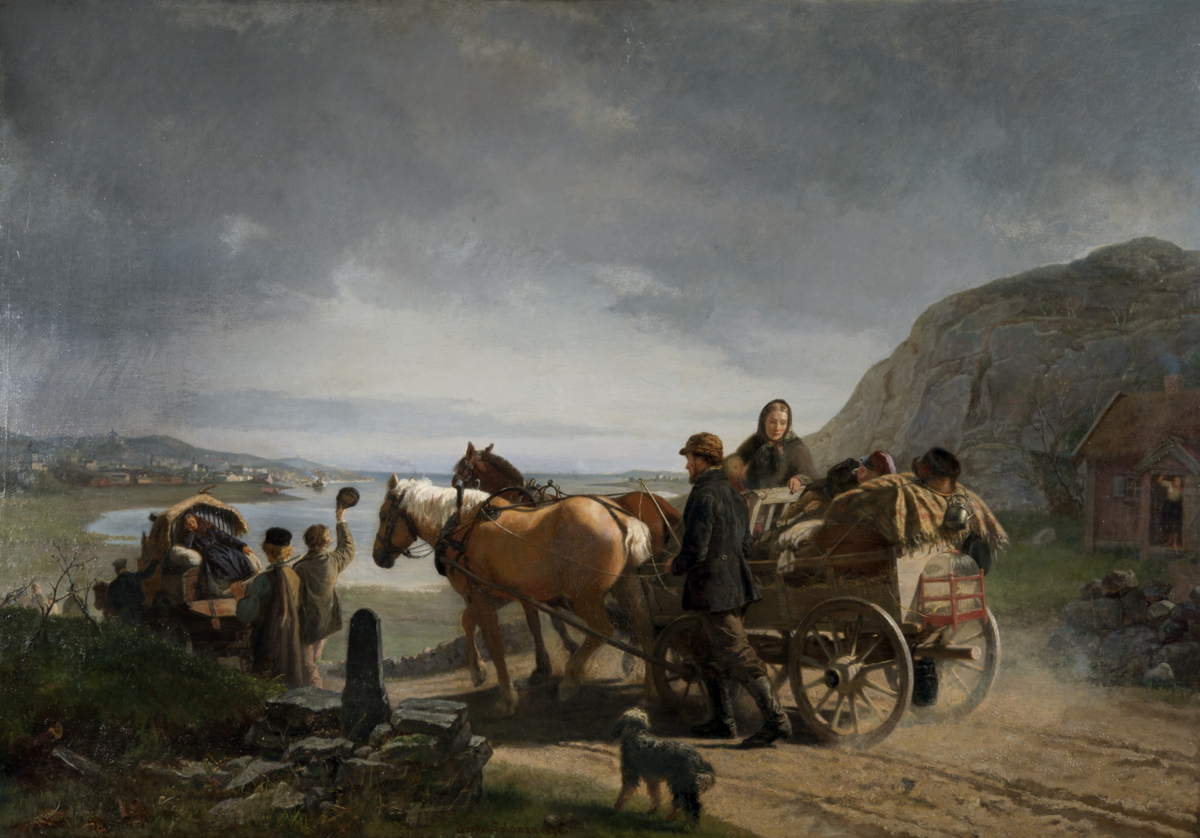
Emigrants on the Way to Gothenburg
Title
Emigrants on the Way to Gothenburg
Dating
1868 - 1872
Material/Technique
Oil on canvas
Dimensions
Mått 143,00 x 204,00 cm
Ram 175,00 x 238,00 x 15,00 cm
Category
Inventory number
GKM 0308
Acquisition
Gift of Pauline Warburg, 1899
Display Status
Description
Geskel Saloman (1821–1902) was born in Schleswig, Denmark, into a Jewish family. He trained at the art academy in Copenhagen and later in Paris for Thomas Couture. Saloman moved to Gothenburg in 1850 where he established himself as a portrait painter. Although he never traveled to Düsseldorf himself, Saloman belongs to the Düsseldorf School, consisting of Nordic artists who trained in Düsseldorf and worked with romantic landscapes and anecdotal genre motifs.
Saloman's most famous painting is Emigrants on the Way to Gothenburg (1868–1872) in the Gothenburg Museum of Art. The large painting (143 x 204 cm) depicts Swedish emigrants on their way to North America in a grand and romantic scene filled with quiet drama. On a dusty road comes a strained crew of people.
Women and children, tired from the journey, sit and lie on the wagons. Behind the first carriage walk two younger men, one of whom raises his cap in an enthusiastic greeting as they come over the crest of the hill and the perspective towards Gothenburg and the river opens up. Closer to the viewer is a carriage with two harnessed horses. A man walks by in high boots and holds the reins. Atop the cart sits a woman in a shawl, nursing a small child as she turns and tries to wake a sleeping older child. Next to the wagon they are greeted by a small dog. In the foreground on the left is a milestone in the shadow by the roadside. In the right edge of the picture, a woman curiously looks out through a doorway to a cabin, situated below a mountain with bare granite rocks. The sky is gray overcast but cracks open at the horizon where the light lies over the looming city. You can glimpse some churches and other buildings and the projecting fortress Skansen Kronan. In the water lies the sailing ship that will take the emigrants across the Atlantic.
You understand that the journey has already been long and tiring. Now hope and excitement are reawakened. They are simple farmers who leave a difficult existence for an uncertain but hopefully better future in America, a country they know very little about. They carry with them the few belongings they can bring. Chests, sacks, blankets, vessels and a birdcage. From the middle of the 19th century to the 1920s, around 1.5 million people emigrated from Sweden mainly to the USA. The emigration intensified in connection with the poor growth years of 1868–1869 when Saloman began work on the painting. It was a large part of Sweden’s population that left the country; among those born in the latter part of the 19th century, 20 percent of men and 15 percent of women emigrated.
Saloman has depicted this theme in a large laid-out image that may resemble a scene in a blockbuster film. It is a powerful drama, not through grand gestures but through the knowledge of the life-changing journey that people are about to undertake. The imagery is realistic without being fussy, but the scene is also highly dramatized. The artist has captured the moment when the travelers reach the crest of the hill and Gothenburg reveals itself. An undulating wavy line runs through the image and leads us towards the goal along the dirt road. Saloman has worked with dramatic lighting with the warm evening light falling in from the right. The wagon wheels gently swirl up some road dust that dances in the light. Saloman wants to awaken our empathy towards the people and their uncertainty about their future.
Kristoffer Arvidsson
Signature/Inscription
Signature (Nere till vänster): Geskel Saloman 1872.
Literature
Georg Nordensvan, Svensk konst och svenska konstnärer i nittonde århundradet. II. Från Karl XV till sekelslutet, Ny, grundligt omarbetad upplaga, Albert Bonniers Förlag, Stockholm (1925) 1928, p. 108
Sixten Strömbom, Konstnärsförbundets historia till och med 1890, Albert Bonniers förlag, Stockholm 1945, p. 100
Viggo Loos, Friluftsmåleriets genombrott i svensk konst 1860–1885, Sveriges allmänna konstförening, Stockholm 1945., p. 57-58, ill. p. 55
Axel L. Romdahl, Göteborgs konstmuseum. Tvåhundra bilder med inledande text av Axel L. Romdahl, Medéns bokhandels aktiebolag, Göteborg 1925., ill. p. 87
Georg Pauli, I vår ungdom, Albert Bonniers förlag, Stockholm 1925, p. 116
Kjell Hjern, Göteborg i konsten. Hur målare och grafiker sett staden under trehundra år, Wesäta Förlag, Göteborg 1961.
Nils-Olof Olsson, Sverige genom konstnärens öga, Arena, Malmö, 2020., ill. p. 142