Hanna Pauli (1864 - 1940)
Venny Soldan-Brofeldt, Artist
Title
Venny Soldan-Brofeldt, Artist
Dating
1886 - 1887
Material/Technique
Oil on canvas
Dimensions
Mått 125,50 x 134,00 cm
Ram 139,00 x 148,00 x 6,00 cm
Category
Inventory number
GKM 0444
Acquisition
Purchase, 1911
Display Status
Description
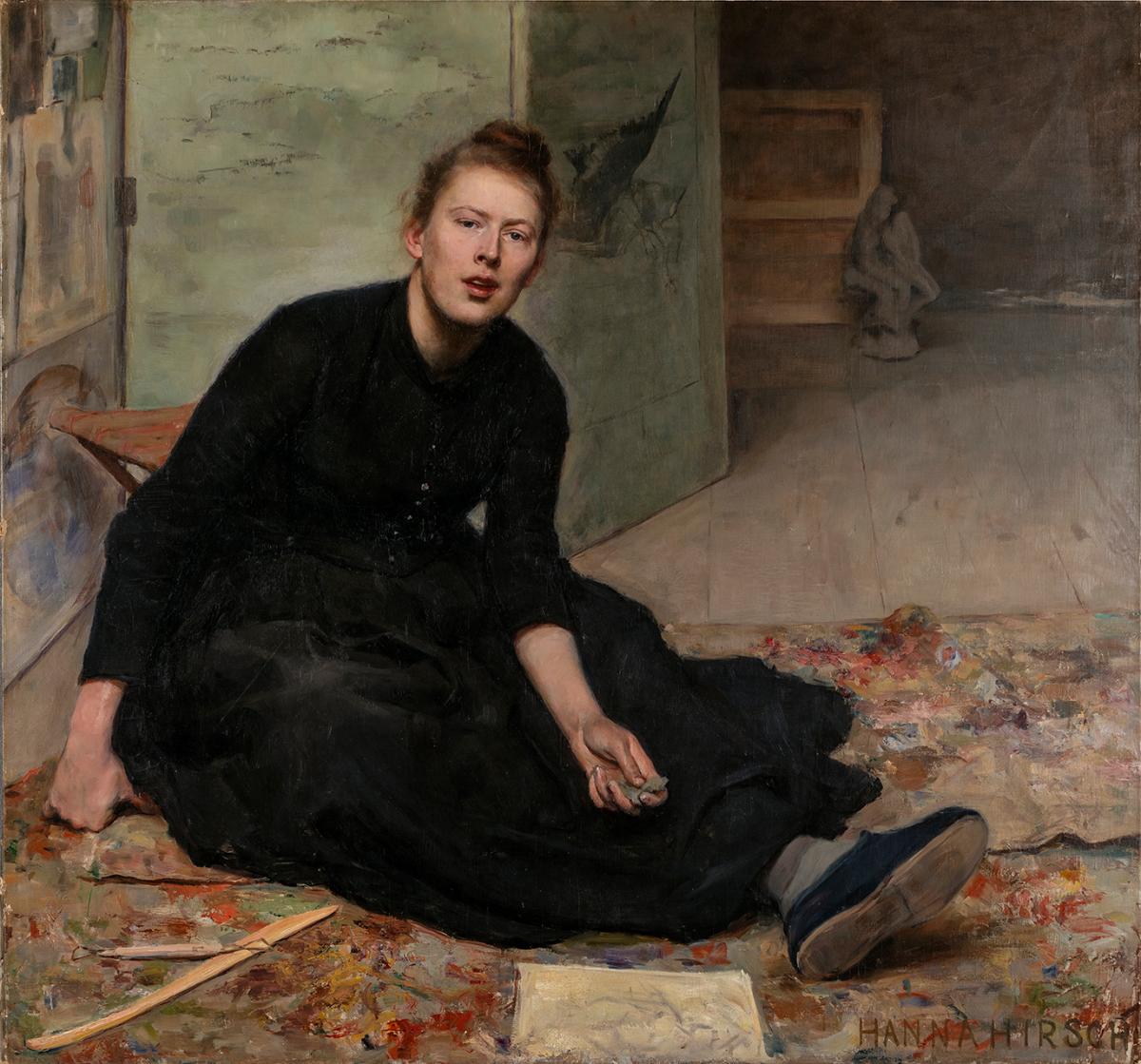
The famous portrait of the artist Venny Soldan-Brofeldt was painted in their shared studio in Montparnasse in Paris in 1887. Pauli has portrayed her friend sitting on the floor, leaning forward with outstretched legs. The woman looks up at us with her mouth half open. She has her right hand on the floor to steady herself, while in her left she is holding a small lump of clay. On the floor are some clay-working tools and a study of a female nude.
Soldan-Brofeldt is shown in the midst of the creative process. She is sitting on a large piece of paper spattered with paint, shown by the wilder use of colour. She is wearing a black dress with her sleeves rolled up, and plain slippers on her feet. Behind her is a Japanese folding screen with bird motifs. To the left, painted sketches are pinned to the wall, and in the background we see the back of a stretched canvas. In the dark at the back of the picture we can make out a sculpture of a couple united in an intense kiss. The painting is in muted colours, with greyish-green and greyish-red tones, black, and ochre.
The room is spartan, but that leaves all the more space for free creativity, far from the social duties of the family at home. Female artists’ friendships were important in a male-dominated art world, where women artists were often regarded with suspicion or scornful forbearance. In Paris, many of the Nordic women artists found a freedom that was denied them on their return to their homelands in the 1890s. Hanna Pauli herself described the circumstances of the portrait in an amusedly Romantic vein:
"We had no major debts at the time. The studio was extremely cold and damp; my Finnish friend had to sit wearing a muff when I painted her. In the bedroom the damp ran down the walls, and there was only a small skylight in the roof. The material side of life troubled us very little at all … Moreover, my friend and I almost always plodded around in slippers; it saved so on shoe-leather and it was so very comfortable."
To show a woman seated in such a relaxed manner was bold for the time: it was considered improper for middle-class women to be so unrefined in their dress and conduct. Pauli has here portrayed a new type of woman, free from the trammels of the bourgeois idea of womanhood. The model’s seated pose may have been inspired by Jules Bastien-Lepage’s painting Haymaking from 1878, which Pauli would probably have seen in reproduction. (Bastien-Lepage was a Realist painter who was the subject of a commemorative exhibition in Paris in 1885.) The Swedish critics praised the painting for its vivid characterization, but were less taken with its colouring, which was considered dull and dry.
In Hanna Pauli’s limited œuvre, her portrait of Venny Soldan-Brofeldt is one of her greatest accomplishments. It is a record of an artistic life on the Continent, with the promise of a free and equal artistic life that was never realized, despite her successes.
Kristoffer Arvidsson from The Collection Gothenburg Museum of Art, Gothenburg 2014
From the research project “The Canon: Perspectives on Swedish Art Historiography”, 2021:
Hanna Pauli’s portrait of the artist’s friend Venny Soldan-Brofeldt, who casually sits on the floor with a lump of clay in her hand, is an example of a work of art whose position in the canon has changed.
Previously, it had no prominent place in Swedish art history. Since the 1980s, when it adorned the cover of the exhibition catalogue They Went to Paris: Nordic artists in the 1880s (Liljevalchs konsthall 1988), it has, on the other hand, been highlighted in the overview works. Since then the painting has been shown more frequently in the museum and is seen as one of the museum’s highlights. It is also a vivid depiction of the life of female artists in Paris during the 1880s.
/The Canon: Perspectives on Swedish Art Historiography/
Signature/Inscription
Signature (Nere till höger): Hanna Hirsch
Exhibition History
Stockholm, Judiska Museet, 18/03/2009 - 18/10/2009
Hannover, Niedersächsisches Landesmuseum, 2002, no. 53
Köpenhamn, Kunstforeningen, 10/08/2002 - 27/10/2002, no. 53
Stockholm, Nationalmuseum, 04/10/2001 - 27/01/2007, no. 29
Jönköping, Jönköpings läns museum, 17/01/1998 - 01/03/1998, no. 4
Stockholm, Prins Eugens Waldemarsudde, 09/10/1997 - 06/01/1998, no. 4
Espoo, Gallen-Kallelan Museo, 07/06/1996 - 01/09/1996, no. 38
Stockholm, Nationalmuseum, 20/10/1995 - 07/01/1996, no. 61
Reykjavik, Listasafn Íslands, 11/08/1995 - 24/09/1995, no. 50
Barcelona, Museu d'Art Modern del MNAC, 02/06/1995 - 16/07/1995, no. 61
Madrid, Museo Nacional Centro de Arte Reina Sofia, 30/03/1995 - 15/05/1995, no. 61
Åbo, Åbo Konstmuseum, 19/09/1991 - 27/10/1991
Göteborg, Konsthallen, 02/09/1989 - 22/10/1989
Stockholm, Liljevalchs konsthall, 16/09/1988 - 06/11/1988
Stockholm, Nationalmuseum, 25/10/1985 - 06/01/1986, no. 88
Paris, Société des Artistes Français, Palais de Champs Elysées, 1887, no. 1217
Göteborg, 1887, no. 44
Paris, 1889, no. 93
Chicago, 1893
Stockholm, 1905, no. 435
Stockholm, Konstakademien, 1933, no. 74
Stockholm, Nationalmuseum, 1945, no. 185
Literature
Lena Boëthius, "Hanna Hirsch och Georg Pauli - kamratskap och samförstånd", Dubbelporträtt. Konstnärskap i seklets början, red. Ingamaj Beck och Barbro Waldenström, Natur och Kultur, 1995, p. 56, 74, ill. p. 55
Dubbelporträtt. Konstnärskap i seklets början, red. Ingamaj Beck och Barbro Waldenström, Natur och Kultur, Stockholm 1995, p. 54-
Georg Nordensvan, Svensk konst och svenska konstnärer i nittonde århundradet. II. Från Karl XV till sekelslutet, Ny, grundligt omarbetad upplaga, Albert Bonniers Förlag, Stockholm (1925) 1928, p. 284, 375, ill. p. 283
Sixten Strömbom, Konstnärsförbundets historia till och med 1890, Albert Bonniers förlag, Stockholm 1945, p. 260, 264, 365, ill. p. bild 111
Jacqueline Stare, "Eva Bonnier och Hanna Hirsch-Pauli i 1880-talets konstliv", Nordisk tidskrift för vetenskap, konst och industri, 1999, p. 325-327, ill. p. 323
Anna Lena Lindberg, "Från kvinnoforskning till genusperspektiv. Om några tolkningar av ett modernt kvinnoporträtt", Könsmaktens förvandlingar. En vänbok till Anita Göransson, red. Göran Fredriksson, Inger Humlesjö, Birgitta Jordansson, Kerstin Norlander, Göteborgs universitet, Göteborg 2003, p. 75-78, 80, 83
Madrid, Museo Nacional Cantro de Arte Sofía, Luz del Norte/Llum del Nord/The Light of the North, red. Cristina Torra León, 1995., no. 61, p. 180, ill. p. 181
Lena Johannesson, ”Sittandets semiotik och den kvinnliga modernismen”, Från modernism till samtidskonst. Svenska kvinnliga konstnärer, red. Annette Götlund, Yvonne Eriksson, Signum, Lund 2003, p. 32, 34-35, ill. p. 34
Anna Lena Lindberg, m fl, Når kvinder fortæller. Kvindelige maleri I Norden 1880-1900, Kunstforeningen, Köpenhamn 2002., no. 53, p. 156, ill. p. 4, 65-76, fig 41
Venny Soldan-Brofeldt, Venny Soldan-Brofeldt och hennes värld. Skisser och minnen, red. Antti J. Aho, Werner Söderström Osakeyhtiö, Borgå och Helsingfors 1947.
Klas Fåhraeus, ”Hanna Pauli”, Ord & Bild, 1924, p. 33-40
Lena Söderlund, Hanna Hirsch. En kvinna i konstnärsförbundet, C-uppsats, 1979, p. 13-14
Stockholm, Prins Eugens Waldemarsudde, Konstnärsparet Georg och Hanna Pauli, red. Göran Söderlund, Carlsson, Stockholm 1997., no. 4, p. 31, 37-40, 66-68, 134, ill. p. 37
Konsthallen Göteborg, Hanna Pauli – Siri Rathsman – Anna Sjödahl, red. Lena Boëthius, Konsthallen Göteborg, Göteborg 1989., p. 2, 5, ill. p. 2
Anon, ”En som kunde varit i tre akademier”, Idun, 1933, p. 338
Ellen Lundberg (f Nyblom), ”Något om våra konstnärinnor. I. Hanna Pauli, f. Hirsch”, Dagny, 1908, p. 115
Jacqueline Stare, ”Eva Bonnier och Hanna Hirsch-Pauli i 1880-talets konstliv”, Nordisk tidskrift för vetenskap, konst och industri, 1999, p. 325-326, 327, ill. p. 323
Stockholm, Liljevalchs konsthall, De drogo till Paris. Nordiska konstnärinnor på 1880-talet, red. Lollo Fogelström och Louise Robbert, 1988., p. 29, 32, 33, 96, ill. p. omslagsbild
Margareta Gynning, ”Ett ambivalent perspektiv. En porträttstudie”, Kvinnovetenskaplig tidskrift, 1992, p. 18-23, ill. p. 19
Barbro Werkmäster, Anna Lena Lindberg, Vi arbetar för livet, 1980., p. 20-21, ill. p. 21
Margareta Gynning, Det ambivalenta perspektivet. Eva Bonnier och Hanna Hirsch-Pauli i 1880-talets konstliv, diss., Stockholm, Uppsala universitet, Albert Bonniers förlag 1999, p. 60-74, 84-86, 132, 149-154, 168, 236-238, ill. p. omslag, 61
Paris, Exposition Universelle de 1889. Beaux-Arts 1789-1889. Catalogue Illustre des Beaux-Arts, red. F-G Dumas, Paris 1889., no. 93, p. 116
Stockholm, Nationalmuseum, Opponenterna av 1885, 1945., no. 185, p. 57
Görel Cavalli-Björkman, Eva-Lena Karlsson m fl, Ansikte mot ansikte. Porträtt från fem sekel, Nationalmuseum, Bokförlaget Atlantis, Stockholm 2001., no. 29, ill. p. 115
Cher Monsieur – Fatala Qvinna. En utställning om konstnärsvännerna Hanna och Georg Pauli samt Venny Soldan-Brofeldt, Stockholm, Judiska Museet Stockholm 2009, p. 18, 37, 125, ill. p. omslag, 37
Prins Eugen, Hanna Pauli, Georg Pauli,, Stockholm, Konstakademien, mars, 1933, p. 6
Carl G. Laurin, Nordisk konst IV. Sveriges och Finlands konst från 1880 till 1926, P. A. Norstedt & Söners Förlag, Stockholm 1926, p. 157, ill. p. 154
Hans Fredrik Dahl, Kasper Monrad, Júlíana Gottskálksdóttir, Soili Sinisalo, Hans Henrik Brummer, Ljós úr Nordri. Norræn aldamótalist/The Light of the North, red. Bera Nordal, 1995., no. 50, p. 152, ill. p. 153
Stockholm, Nationalmuseum, 1880-tal i nordiskt måleri, red. Pontus Grate och Nils-Göran Hökby, Nationalmuseum, Stockholm 1985., no. 88, p. 214-215, ill. p. 215
Stockholm, Nationalmuseum, Nordiskt sekelskifte/The Light of the North, red. Karin Sidén, Kaspar Monrad, 1995., no. 61, p. 172, ill. p. 173
Axel L. Romdahl, Göteborgs konstmuseum. Tvåhundra bilder med inledande text av Axel L. Romdahl, Medéns bokhandels aktiebolag, Göteborg 1925., ill. p. 175
Kati Kivimäki, Kerttu Karvonen-Kannas, Riitta Konttinen, à Paris! Pohjoismainen taiteilijasiirtokunta Pariisissa 1800-luvun lopussa/Nordiska konstnärer i Paris i slutet av 1800-talet/Norid Artists in Paris in the Late 19th Century, red. Kerttu Karvonen-Kannas, Tuija Möttönen, Gallen-Kallelan Museo, Espoo 1996., no. 38, ill. p. 60
Georg Pauli, Konstnärsbrev II, Albert Bonniers förlag, Stockholm 1928, p. 15
Kristoffer Arvidsson, Per Dahlström, Björn Fredlund, Anna Hyltze, Philippa Nanfeldt, Isabella Nilsson, Johan Sjöström, Samlingen Göteborgs konstmuseum, red. Kristoffer Arvidsson, Per Dahlström, Anna Hyltze, Göteborgs konstmuseum, Göteborg 2014., p. 196-197, 199, ill. p. 198
Women Artists in Paris, 1850-1900, red. Laurence Madeline, American Federation of Arts, Yale University Press, New York, New Haven och London, 2017., p. 96, ill. p. innehåll, 97
Carina Rech, Becoming Artists. Self-Portraits, Friendship Images and Studio Scenes by Nordic Women Painters in the 1880s, Makadam/diss. Stockholms universitet 2021, Stockholm, 2021., p. 11-13, 217-222, 237, 251-255, 267, ill. p. 12, 216
Karin Sidénoch Carina Rechoch Katarina Wadstein MacLoed et al., Ett eget rum. Konstnärsrollen under det sena 1800-talet, red. Carina Rech och Karin Sidén, 2021., no. 28, p. 21-22, 27-31, ill. p. framsida, 20, 180
Susanna Petterson och Nils Ohlsen och Martin Olin och Eva-Lena Bergström och Marja Lahelma och Alexandra Herlitz och Tonje Haugland Sörensen och Anna-Maria von Bonsdorff och Monica Grini och Carina Rech och Patrik Steorn och Jessica Sjöholm Skrubbe och Peter Norgaard Larsen och Michaela Giebelhausen och Susanna Pettersson, Nordic art & way of life. Art world. Artists. Themes, red. Susanna Petters & Anna-Maria von Bonsdorff, Mercatorfonds, Bryssel, 2024., ill. p. 170
Sylvie Camet, Femmes assises, Lisières, 2024., p. 83, ill. p. 82
Weblink